Inventa: Decentralized Self-Improving Agents
for Autonomous Scientific Discovery

Inventa runs many autonomous research units in parallel. Each unit evolves its own lineage of ideas and its own proposal mechanism, and units communicate only through a shared knowledge that verifiers alone write.

Prithwish Jana1,†, Nikos Kanakaris2, Purak Jain2, Anoop Deoras2, Sahika Genc2

1Georgia Institute of Technology2Amazon

Georgia Institute of Technology Amazon Web Services

†Work done while at Amazon.

Video overview

See how Inventa works

Autonomous research units explore in parallel, evolve how they propose ideas, and share only what verifiers confirm.

TL;DR

  • The setting. LLM agents can generate research ideas and improve scientific discovery through iterative experimentation, across retrieval, ideation, proposal writing and law discovery.
  • The problem. More agents or more iterations do not automatically produce more diverse or feasible ideas. Agents converge on similar candidates, propagate unsupported claims through shared memory, and keep applying search strategies that no longer yield improvements.
  • What Inventa does. It runs autonomous research units, each with a lineage of candidate ideas written by a mutator agent. A local orchestrator agent periodically adapts the mutator's harness; when progress stalls it replaces the model or restarts the lineage. Verifiers evaluate every candidate and record verified improvements, useful components and constraint violations in a shared knowledge, the only channel between units.
  • The effect. Inventa leads all five benchmarks: 73.6% on EurekaBench versus 56.2% for CORAL, and 26.0 novel ideas per paper on IdeaBench versus 18.6 for ResearchAgent, with 82% fewer model calls.
01

One round of Inventa, step by step

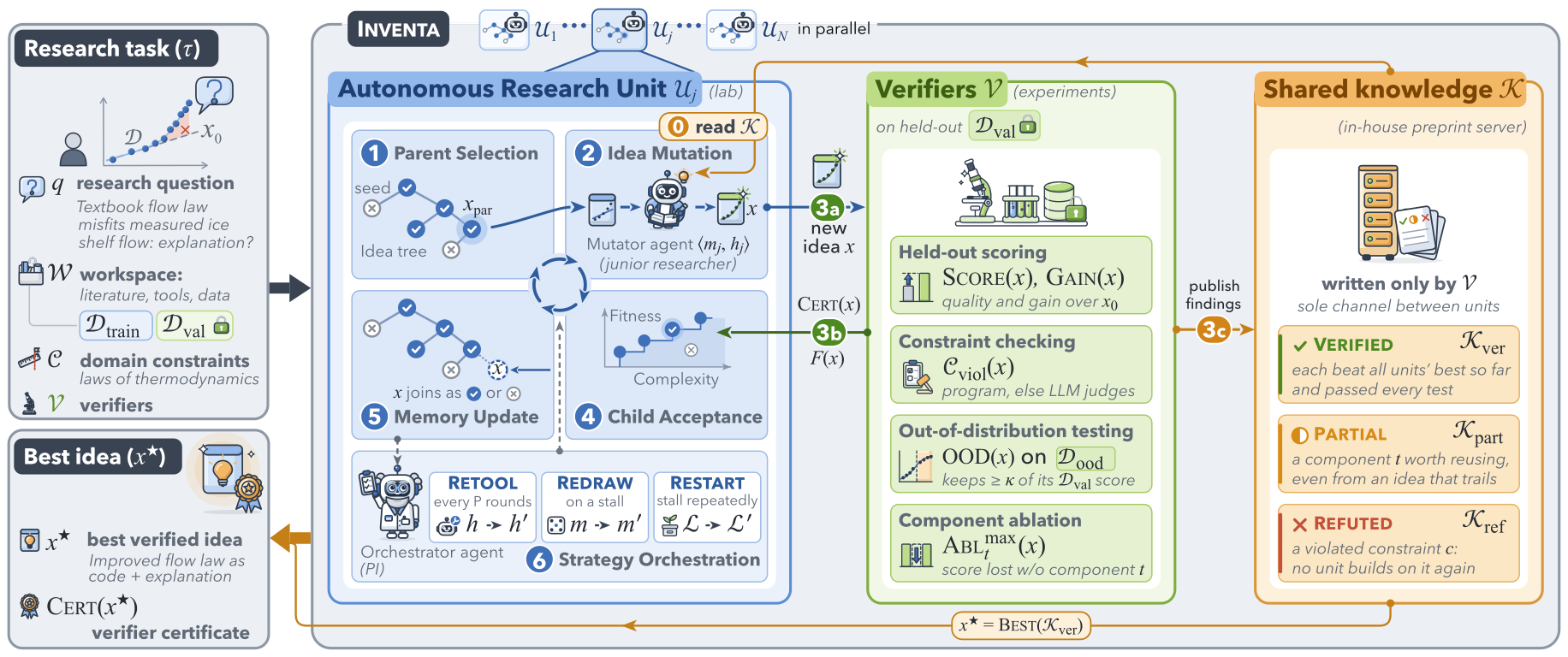
Given a research task, Inventa generates novel and verified ideas. Step through Figure 1 of the paper: click a step, or let it play.

02

Four challenges, four design choices

Recent AI co-scientists coordinate multiple agents to generate, test and refine hypotheses. Four challenges remain; Inventa answers each with one component, modelled on how research groups pursue different approaches while building on evidence reported by others.

1 · Diversity

Maintaining diversity as search grows

Systems largely follow myopic hill-climbing, which narrows the exploration radius; extra samples or iterations yield increasingly similar candidates.

Autonomous research units. Each unit, like a lab, keeps its own idea lineage and advances at its own pace. A stalled unit redraws its model or restarts with a new seed idea.

2 · Sharing

Sharing knowledge without propagating errors

Isolated agents cannot benefit from one another's findings, while interacting agents converge; unverified claims influence later attempts.

Verified shared knowledge. Only verifiers write to it, and they publish three kinds of findings: verified bests, partial components worth reusing, and refuted constraint violations.

3 · Self-adaptation

Adapting the proposal mechanism

Refining ideas does not change the prompts, tools or control flow used to generate them, so iterations improve ideas but do not expand the search space.

An orchestrator per unit. Acting as a meta-mutator, it evolves the mutator's harness and keeps an edit only if twin trials show significantly fitter children.

4 · Feasibility

Satisfying scientific constraints

Highly novel ideas often prove infeasible under the task's assumptions or physical requirements: a novelty–feasibility gap.

Verifiers with a certificate. Every candidate is scored on held-out data, checked against domain constraints, tested out of distribution and ablated component by component.


How Inventa differs from existing search

View the full figure
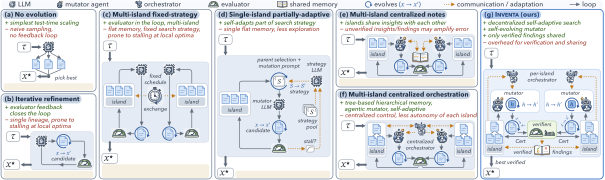
Figure 2 · Comparison of search mechanisms. Prior methods (a)–(f) range from repeated sampling to island-based evolution with fixed, partially adaptive, or centralized strategies; all keep the mutator fixed. In Inventa (g), each decentralized unit has a local orchestrator that evolves its mutator, while only verifiers publish shared findings.
03

Method

Inventa separates three operations: developing candidate ideas, self-adapting the process that develops them, and determining which findings can be shared. Units pursue different approaches while receiving, only through shared knowledge, common evidence about successful candidates, useful components and observed constraint violations.

Component I

Autonomous research units

A unit's state is its lineage memory, an idea tree of the candidates it has explored, and its current mutator, a model run in a harness. Each node holds an idea, its certificate of verifier evidence and an acceptance label.

The mutator writes a child from the parent, its certificate, recent lineage nodes and a snapshot of the shared knowledge. It runs in a sandbox where validation and test data are inaccessible.

Component II

Verifiers

The verifiers evaluate each candidate against the baseline and the constraints, and return a certificate recording the outcome of every check and the evidence behind each failure.

  • Held-out scoring on the validation split, with the gain over the baseline.
  • Constraint checking, programmatically or by LLM consensus.
  • Out-of-distribution testing on a held-out data regime.
  • Component ablation: the score lost without each component.

Component III

Verified shared knowledge

Verifiers write to it; units read it at the start of every round. It is the sole channel for inter-unit communication.

  • Verified beats every unit's best so far by a noise margin and passes every check. This raises the bar for all units.
  • Partial a component worth reusing, even from an idea that trails.
  • Refuted a confirmed constraint violation, so other units avoid it and prune their search.

Every round, five stages each unit advances at its own pace, with a bounded lag

1

Parent selection

Thompson sampling over the accepted nodes, treated as arms of a multi-armed bandit rewarded by fitness: promising lineages are exploited, nodes with few children are explored.

2

Mutation

The mutator diagnoses the parent and revises it into a child idea, fitted on the training data.

3

Verification & sharing

The verifiers test the child, return its certificate, and publish qualifying findings to the shared knowledge.

4

Child acceptance

A child is accepted only if no accepted idea is at least as simple and nearly as fit; extra complexity must improve fitness.

5

Memory update

The child joins the lineage. Rejected children remain as negative evidence; every scored child updates its parent's value.

The orchestrator adapts its unit three actions, the only ones it takes

Retool

evolving the harness · every P rounds

Diagnoses traces of recent attempts and proposes a new harness. A twin trial runs both harnesses on the same parent and mutation plan; the new one is adopted only if the scored pairs give a significantly positive mean difference.

Redraw

replacing the model · on a stall

The shared knowledge tallies each model's recent fitness improvements; the orchestrator draws a better-performing model from this tally by Thompson sampling, keeping the harness.

Restart

changing direction · stall repeated

If the unit stalls again after a second Redraw with no verified finding, it archives the lineage and proposes a new seed idea from the shared knowledge.

04

Results

Inventa is evaluated at four stages of the research cycle on five benchmarks: retrieving prior work (ScholarCatalyst, 894 queries), generating ideas (IdeaBench, 736 test papers), writing grounded proposals (IdeaScientist, 277 problems), and discovering scientific laws (EurekaBench, 16 tasks; SciLaws-Bench, 38 tasks). Baselines include frontier AI agents, SoTA evolutionary search and AI co-scientists. All numbers are from the paper.

AInventa leads at every research stage. Relative gain over the best baseline (gray) on each benchmark’s primary metric, with the absolute values.
BScientific law discovery keeps improving with budget. EurekaBench conditioned score on validation vs. cost per task (units of 10 USD). Inventa after 10 and 20 rounds.
CMore novel ideas for fewer model calls. IdeaBench distinct novel ideas per paper (rated ≥7) vs. model calls per paper, in the 27-, 122- and 241-idea settings.

Benchmark by benchmark

Show as a table

Consistent with domain constraints

16/16

EurekaBench tasks on which Inventa’s law passes every scientific-constraint test. No other method passes them all: Agentic Scientist passes 15, CORAL 13.

Beats the published law

31/38

SciLaws-Bench tasks where Inventa's law beats the published one, against 28 for the best baseline; its edge lies in tasks that hold out entire groups (65.8% vs. at most 61.4%).

Robust to the judge

IdeaBench re-scored with two judges unused in search: Inventa still finds the most distinct novel ideas (17.5 and 13.5 vs. 13.1 and 11.3 for OpenEvolve).

05

Discoveries

06

BibTeX

@article{jana2026inventa,
  title   = {Inventa: Decentralized Self-Improving Agents for Autonomous Scientific Discovery},
  author  = {Jana, Prithwish and Kanakaris, Nikos and Jain, Purak and Deoras, Anoop and Genc, Sahika},
  journal = {arXiv preprint arXiv:2611.21847},
  year    = {2026},
  url     = {https://arxiv.org/abs/2611.21847}
}

Acknowledgements. We thank Prof. Vijay Ganesh (Georgia Institute of Technology) for his fruitful feedback and insightful discussions throughout this project, which helped us improve this paper.